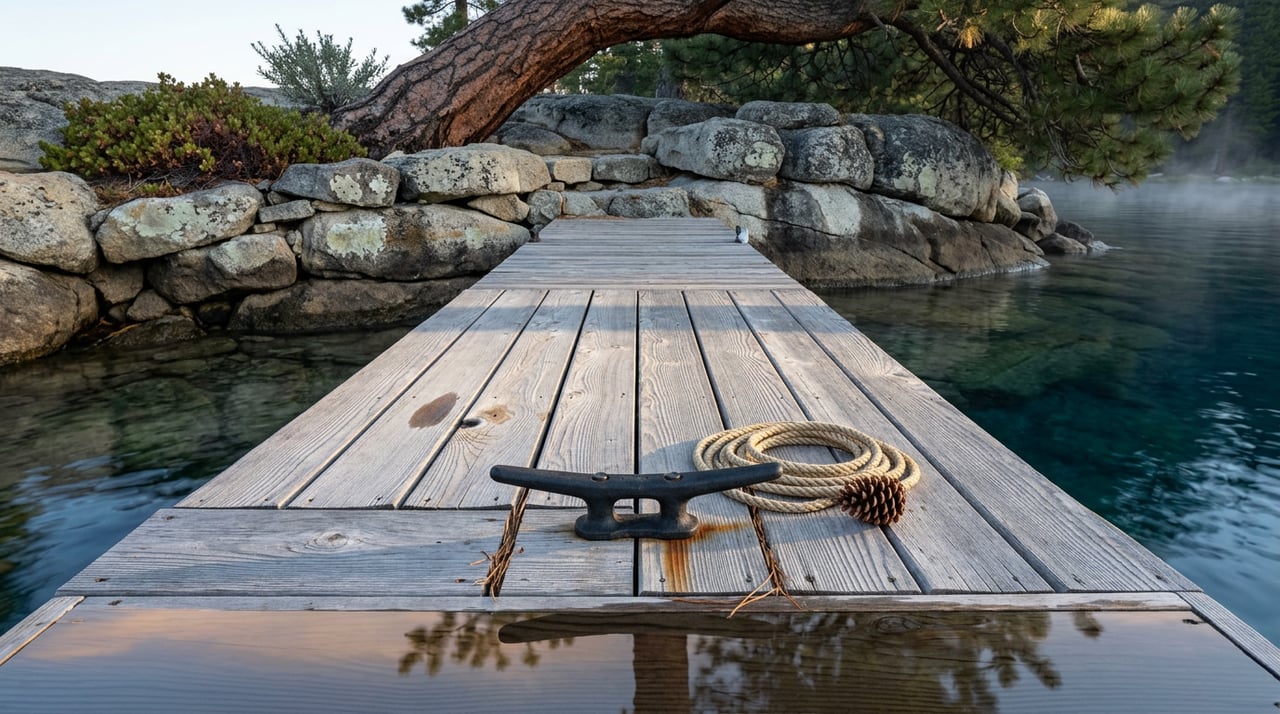
If you buy a Crystal Bay lakefront home advertised with a private pier and two buoys, how much of that water access is actually yours the day escrow closes?
Most buyers assume the answer is all of it. The listing photo shows the dock. The MLS sheet lists the boat lift. The seller has used the buoys every summer for a decade. It feels settled, the way a garage or a fireplace feels settled. Then the title company or the buyer's agent starts pulling permit history and the picture gets more complicated, because a pier and a buoy at Lake Tahoe are not simply features of a house. They are separate, government-issued rights that sit on top of the house, and the Tahoe Regional Planning Agency has been direct about the limits of what a piece of paper actually proves. On its own mooring registration system, the agency states plainly that registering a mooring is not evidence that the mooring legally exists. That single line reframes almost every water-access claim in a Crystal Bay listing.
Why This Matters More in 2026 Than It Did a Few Years Ago
Crystal Bay's lakefront tier has had a strong run. The neighborhood posted a $46 million lakefront sale in 2026, a record for the community, and lakefront medians there have reportedly moved up roughly 27 percent year over year as of mid-2026. When prices climb that fast at the top of the market, the value attached to a private pier or a legal buoy climbs with it, because water access is the scarcest input in the whole transaction. A home with a confirmed, transferable pier permit and a home with an unpermitted "legacy" dock can carry very different valuations even when the structures look identical from the water. That gap only shows up when someone actually checks the paperwork, which is exactly the diligence step that gets skipped when a deal is moving fast and everyone assumes the dock just comes with the house.
Crystal Bay's shoreline stock makes this more likely to surface than in newer developments. The community's granite frontage has drawn homeowners for decades, long before the current shorezone rules existed, and TRPA's own registration process still makes room for moorings that predate 1972 as long as the owner can document that the structure existed back then. That is a meaningful clue about how many Crystal Bay piers and buoys are running on grandfathered status rather than a clean, current permit.
Piers and Moorings Run on Two Completely Different Clocks
The first thing most buyers get wrong is treating "water access" as one category. TRPA regulates piers and moorings (buoys, boat lifts, and slips) as separate structures with separate allocation systems, separate caps, and separate odds.
| Piers | Moorings (buoys, lifts, slips) | |
|---|---|---|
| Lottery frequency | Every two years, held in odd years | Every year |
| Basin-wide new allocations | Up to 12 new piers per two-year cycle | Up to 1,486 new private moorings released in staged annual pools |
| Most recent cycle | June 2025 drawing: 56 proposals submitted, 52 eligible; TRPA awarded 2 single-parcel piers (both on the California side) and 11 multiple-parcel piers | October 1 through November 14, 2025 window closed without a random drawing, because submissions came in at or under the available pool, and eligible applicants received allocation letters directly |
| Next opportunity | June 2027 | Annual, but the exact 2026 window had not been announced as of this writing |
| 2026 TRPA application fee | Minimum $6,623 plus a separate deposit | $1,581 per buoy or structure |
The pier numbers tell a stark story for Crystal Bay buyers who assume money solves the problem. In the most recent cycle, both single-parcel pier allocations basin-wide went to California-side properties. Nevada shore applicants, Crystal Bay included, received zero individual pier allocations that round. If a Crystal Bay listing does not already have a legally documented pier, the realistic path to getting one is either a multiple-parcel, shared-use application (TRPA gave out 11 of those) or waiting for June 2027 and hoping for better odds, not writing a bigger check.
Moorings are a different story, and a more forgiving one. The 2025 window didn't even require a drawing, which means every eligible littoral owner who applied with a current Best Management Practices certificate got an allocation letter. That is genuinely useful for a buyer who wants to add a buoy to a Crystal Bay parcel that doesn't have one yet. It is a real possibility on a real annual timeline, not a long-shot lottery. The catch is that the BMP certificate has to already be in place before you can even enter, so a property without stormwater compliance work done is further from a new buoy than the calendar suggests.
The Legacy Buoy Problem
Here is where the fine print matters most. TRPA's registration system states that once a property changes hands, an existing mooring's registration carries over automatically. That sounds like protection. It isn't, entirely. The same system is explicit that registration itself is not proof the mooring is legal. A buoy can be registered, fee-paid, and listed on the parcel record, and still be the kind of pre-permit structure that TRPA could eventually require to be removed if it determines the mooring was never properly authorized in the first place.
This is the gap between "documented" and "defensible." A Crystal Bay seller who has paid the annual registration fee for fifteen years has documentation. Whether that documentation traces back to an actual TRPA permit, a pre-1972 proof-of-existence filing, or nothing more than an unbroken habit of paying a fee is a separate question, and it's the one a buyer's title work needs to answer before contingencies come off.
HOA Water Access Runs on Its Own Set of Rules
Crystal Bay's shoreline isn't uniform, and the diligence questions change depending on which kind of ownership you're looking at. Stillwater Cove, the gated enclave of 47 townhomes on 24 acres with its own private marina and buoy field, holds a master TRPA permit at the association level. Individual owners there are assigned a slip or buoy through community policy rather than holding an individual TRPA permit in their own name. Buying into that structure means the diligence question isn't "does this specific buoy have a clean permit," it's "does the HOA's master permit cover the unit I'm buying, and what's the association's policy for reassigning access at resale." Newer condominium developments in Crystal Bay, including Granite Place and Boulder Bay Resort, follow a similar shared-access model rather than individual shorezone rights.
A private single-family lakefront lot works the opposite way. There, the permit (or its absence) attaches to that one parcel, and the paper trail is yours alone to verify.
Before You Remove Contingencies on Crystal Bay Water Access
- Request the specific TRPA permit number for any pier, and confirm it independently through TRPA rather than relying on the seller's representation.
- Check the mooring's registration history and ask directly whether the registration is backed by an actual permit or a pre-1972 proof-of-existence filing.
- Confirm the parcel's Best Management Practices certificate is current, since it's required before any new mooring application and it can also be relevant to how existing structures are treated.
- If the property sits in an HOA-controlled buoy field or marina, request the association's master permit documentation and its policy for assigning or transferring slips at resale.
- Ask when the last TRPA compliance check occurred and whether any violation notices exist on the parcel record.
What This Means If You're Selling
The same gap that creates risk for buyers creates leverage for sellers who do the work early. A Crystal Bay listing that can point to a verified TRPA permit number, a current BMP certificate, and a clean registration history is offering something increasingly rare on this shoreline: certainty. In a market where lakefront medians have moved up sharply and every water-access structure is effectively irreplaceable under the current lottery caps, that certainty is worth documenting before the home goes on the market, not scrambling to produce it once a buyer's attorney asks.
A Few Direct Questions
Can I just add a buoy after I close if the home doesn't have one? Possibly, and more realistically than adding a pier. The annual mooring lottery has recently allocated enough slots that eligible applicants with a current BMP certificate haven't needed a random drawing to get an allocation letter. It's a real path, just not an instant one.
What if I want to build a new private pier? Plan on a long timeline. TRPA allows up to 12 new piers basin-wide every two years, the next lottery opens in June 2027, and the most recent cycle sent both single-parcel allocations to the California side. A shared, multiple-parcel application has better odds than an individual one.
Does a documented, decades-old buoy mean I'm safe? Not automatically. Registration and payment history are not the same as a verified TRPA permit. Ask for the underlying authorization, not just the fee receipts.
Water access is the single hardest thing to verify and the single most valuable thing to get right in a Crystal Bay lakefront purchase or listing. If you're weighing a property with a pier, a buoy field, or an HOA-controlled marina slip, Incline Experts can help you get the permit history straight before you're staring down a contingency deadline. Book an Appointment to talk through the specific parcel you're considering.